Tiny Bunny

Review
Slavic Stranger Things
by Samuel Corey
reviewed on PC
Bildungsroman Horror
Perhaps it shouldn't be surprising that there are so many horror stories that double as coming-of-age stories. From Stephen King's It, to Dan Simmons' Summer of Night, Ray Bradbury's Something Wicked This Way Comes, to Robert McCammon's Boy's Life, to Stranger Things, the genre combination has remained popular for a very long time. It works because the end of childhood is an innately frightening thing, being a time when you are not quite free of the childish fears of darkened rooms and skulking boogeymen, but are also being confronted by the fact that the adult world is much larger and much more frightening than you have otherwise suspected. Moreover, it's inherently relatable as every adult was once a barely pubescent child, unsure of how to navigate the rocky path of adolescence.
Yet, as much as I admire some of the works I mentioned above (particularly Summer of Night), I have always felt that every work has failed to capture the entire possible spectrum that the genre offers. Each work neglects some aspect or other that makes the experience of near adolescence frightening, even as they nail other facets. Boy's Life and the first season of Stranger Things, for instance, do not even pretend that there is anything magical about the menace lurking in their shadows, missing out on children's unique ability to believe in monstrous fairy tales. Steven King's It, in addition to its dreadful ending, does little to show its grade-school protagonists being frightened of an adult world they do not fully understand, with most of the terror coming from the spooky clown monster stalking them. Even Summer of Night leaves aspects of potential horror unexamined by not, for instance, using body horror as a metaphor for puberty.
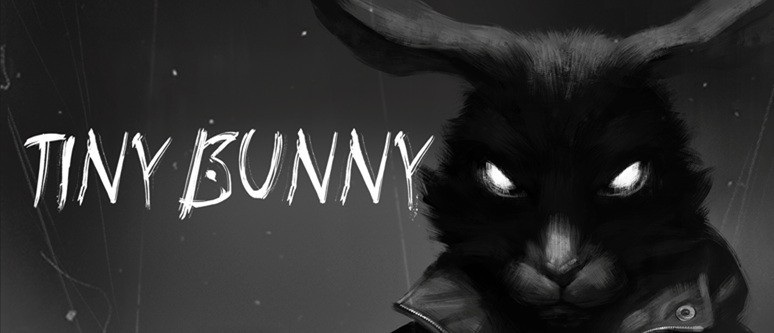
Crafting a horror story that captures every possible way in which the end of childhood can frighten is no small task, as there are so many ways in which growing up can be frightening. Indeed, I thought it wasn't possible until I played Tiny Bunny, a new Russian choose-your-own-adventure visual novel which has to be the single most succinct encapsulation of juvenile horror ever assembled.
The game is told through the viewpoint of Anton Petrov, a twelve-year-old boy growing up in Russia's Wild Nineties. He has recently moved from the big city to a tiny, rural hamlet in the Taiga along with his mother, father, and little sister Olya. The mundane fears of starting a new school, making friends, and dodging bullies are augmented by darker rumors in the town about a series of children that have gone missing in the forest. The police are hunting for a serial killer or a kidnapper, and no one is above suspicion.
Additionally, there is some implication that Anton and his family didn't just move to the middle of Siberia for the fresh air and colorful locals. We see at one point that Anton's father keeps a handgun in his car, and we overhear arguments between Anton's father and mother where his mom speaks darkly about his father's ruthless business associates. Just what Anton's father has gotten up to is unclear, but it is painfully obvious that he is not just an accountant like he claims to be. Looming threats potentially endanger Anton and his sister from the adult world that they have little to no understanding of.
Yet those are not the only dimly-seen menaces facing the children, as both Anton and his sister have seen strange shapes prowling in the forest. Beasts that walk upright and dance to eerie music in the moonlight. Creatures straight out of a twisted fairy tale that tempt the children into the woods with offers of treats, powers, and companionship.
Amazingly, Tiny Bunny keeps all these plates spinning with an effortless grace. Every piece of the mystery feels consequential, and even when something is ultimately revealed to be a red herring, it still adds to the overall atmosphere of the work. Even plot threads that I was initially concerned about, like Polina, the beautiful girl who inexplicably falls for Anton, pay off massively and add to the feeling of dread and confusion that hangs over the game.
An Interactive Audio-Visual Novel
Normally, there is little to recommend reading a visual novel over a regular book aside from a few slick illustrations and maybe a couple of graphic hentai sex scenes. Even when the story being told is excellent, like Saya No Uta, a lot of potential from the medium is being unfortunately left on the table. Sound effects and music are usually included to enhance a player's immersion, of course, but many games keep these to an absolute minimum.
Tiny Bunny spares no expense in this department. Not only does it boast some truly eerie sound design, the best I've seen in any horror visual novel other than perhaps Higurashi When They Cry, it also maintains a unique and intriguing visual style throughout. The game has a good sense of when to shift perspective, add small animations, and subtly change its art style in order to better convey its atmosphere. The audiovisual element of the game is as compelling as its narrative.
Additionally, the game boasts a robust set of choices to make, with multiple consequential differences in every chapter of the game, giving the player a degree of investment in the character and his decisions that is often lacking in visual novels.
Conclusions
Those choices are not trivial either. Each one will have an impact on how scenes play out and how the overall story progresses, which is why even this relatively short game has so many endings. I have only gotten a couple of endings myself, but it is clear that there is a wild variation in the level of depth and quality between these endings. For instance, in one case, making a decision in the game's final episode will prematurely catapult you into a relatively slapdash and confusing ending, whereas making another choice sends you down a much longer decision path that will end with a much more satisfying and involved ending. I suspect that this is part of what has driven the overall negative response to the game's final chapter. If I had stopped playing after one ending, I would be a little disappointed too!
Moreover, a horror story that is driven so much by mystery and intrigue will always be disappointing in the conclusion. Either the mystery will be solved, or we lose the delightful ability to speculate about what this piece of evidence or the other means. A whodunit can wrap everything up with a neat little bow and be satisfying in its perfection, but a horror mystery loses all ability to terrify and intrigue once it is dragged into the light. But on the other hand, when threads are left dangling at the end, it feels a little bit infuriating. If you have been following this game's development closely since its first release in early access in 2020, this frustration will be all the greater.
Still, if you can overlook the inherently frustrating endings, Tiny Bunny is a masterwork of coming-of-age horror. I cannot recommend this game highly enough.
As always, follow Hooked Gamers on Instagram for news updates, reviews, competitions and more.
9.5
fun score
Pros
Masterful blending of mundane and supernatural horrors. Very strong writing and character work. Brilliant use of sound and imagery.
Cons
Some endings feel lacklustre


