Skate Story

Review
Skateboarding is not a sin, and Sam Eng is not the devil.
by Jordan Helsley
reviewed on PC
Glass Demon's Inferno Pro Skater
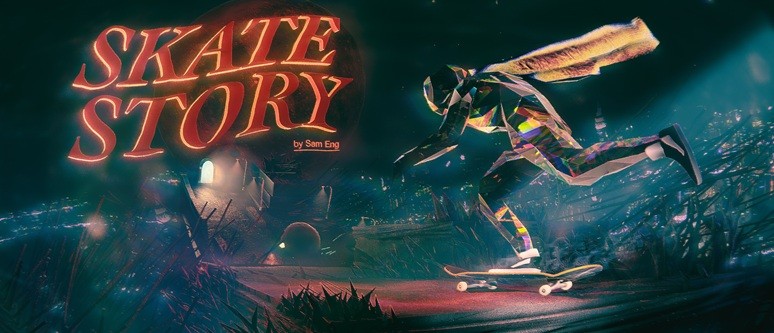
The broad strokes of Skate Story's narrative might feel familiar, especially if you’re like me and had to read The Divine Comedy a dozen times to comprehend it all. Like Inferno, our hero is guided through the circles of Hell towards a frozen lake at the "bottom." The first circle is home to the philosophers, the ceaseless rains are here, and our hero is hungry for some moons. It's basically the same, except for the moon part, and plenty of other areas. While Dante seems to be an inspiration, the story feels more personal, and less about broadly confronting your sins whilst visiting Impressario's Casino. In some aspects, it rejects that theme and instead our demon helps others exact revenge or fuel their greed in the interest of furthering their own escape from damnation. It's not an overly serious story, though. Most of the points and lessons sprinkled throughout are couched in some fairly effective humor from this cast of supporting characters.
Throwing aside the biblical roots, and the other arguably cultural aspects meshed in, like the central moon eater and world serpents, Skate Story relies on a lot of obscurity to tell its story, and the story of several tangential characters you run into throughout. These cryptic dialogues work a lot of the time to engage with the world and decipher what's going on with reasonable accuracy, but in other cases they hamper the enjoyment of interacting with the other souls you meet. Usually you'll interact with a character, they'll say something on a varying scale of cryptic, and you'll move on, with the opportunity to speak to them again. These characters don't have conversations, though, so you're greeted with the same dialogue yet again, and it takes a handful of seconds too many to button through, so it amounts to a minor lack of respect for the players' time when these interactions add up. Extend this out to other intractable objects in the world, and it can become frustrating for those that want to maximize their experience without retreading ground. And it's exacerbated when you realize there are enigmatic quests sprinkled throughout. Without the ability to discern the worthwhile interactions from the useless it makes the process of exploring the world feel a little too much like a chore, especially on the second playthrough. I found most of these bits of dialogue worth parsing, at least the first time, in an attempt to decipher more about the world and characters, but repeated readings did not have the same effect for me as Dante's novel.
Skating With The Devil
It's easy to forgive Skate Story's perplexing quests or distractions because it feels very good to play. To get it out of the way: tricking is probably unlike anything you've experienced so far. While skateboarding in video games is usually about timing and positioning, the system here takes a unique approach to representing that feel. Flip tricks are performed by using the shoulder buttons (either individually or in a prescribed combo) and the Ollie button. When you "activate" a trick, or just hold the Ollie button, a pattern appears on the screen that increases complexity as the trick itself does. A standard Ollie has an oval, a kickflip has a figure-8, and so on. A small indicator moves around the "track," and the proximity to the designated sweet spot determines the height and score obtained as the trick is executed. This system provides this extra layer of complexity to timing something like a pop onto a grind, as the physical positioning of you and your board needs to line up to the meter's positioning for maximum effect. The trade off is you cannot fail a trick by not getting enough height to complete it, as wipeouts are relegated to colliding with obstacles. In fact, the beautiful animations of the character and the board are so perfectly timed that it nearly always makes the landing look gracefully and perfectly-timed.
Grinds are executed as you might expect: without a dedicated button, just falling onto a rail or ledge, and you can adjust the board with the left stick from there to angle it and perform a different grind. Manuals are similar, in that they're pulled off by a slight pull of the stick, and grab tricks are absent, unless I missed something big there. I initially had concerns about the number of tricks in the arsenal, but I can safely say it's not an issue, with more complex tricks not only present, but requiring a sufficient amount of skill and memory.
The other somewhat unique aspect of the gameplay loop is the focus on speed. Going fast increases score, and many of the levels are designed in a linear track style, combining standard street skating with downhill "bombing," which is where the difficulty comes from. Taking tight turns, performing tricks and hitting grinds that are rapidly approaching, and engaging in "combat," so to speak. Boss fights, in particular, usually have designed zones that move around an arena in which you need to "stomp" tricks in to deal damage by pressing a button before landing, which cashes in the built up score and combo to deal damage. Without moving quickly, performing a variety of tricks, and avoiding obstacles, these encounters end up vastly different in practice. It feels surprisingly good to pull off a series of tricks and stomp a nice combo to deal a chunk of damage, but the design of their health feels tuned too far in the direction of friendly, and away from challenging or truly satisfying. Each boss has a health bar that is broken up into chunks, six to a dozen, or so, which appear to have a minimum amount of damage to eliminate, but an infinite amount at the maximum. So a chunk of health can be taken out by a 10,000 score combo, but a 100,000 point combo doesn't take out ten of them, it just takes the one. I think we all have a built-in desire to see our skill manifest in more effectively dealing damage in combat, but that's not present here so it ends up a bit disappointing, and a contrast to the rest of the game's feel.
If You're Skating Through Hell
For the most part, Skate Story keeps the inertia of its gameplay going throughout its runtime. Most of the main quests are straightforward and uncomplicated, but there are a few moments where the pacing screeches to a halt for extended periods of time. Similar to the obscure side interactions, a few story beats had me concerned that something broke in the code, either because of a carbon copied cutscene and objective or because I genuinely couldn't tell what the game wanted me to do to progress. These instances are rare enough to not drag the entire experience down too much, but they also almost exclusively came towards the end, which added a bit of extra annoyance.
Still, once the credits rolled I only wanted to play some more. Not only because there were clearly things I missed (and couldn't find the second time around), but because it looks, feels, and sounds great to be in this world. The soundtrack, primarily by Blood Cultures, is incredible, and gives me something to look forward to on release day, but the overall sound design holds its own, too. The wheels rolling on the ground, the screech of a power slide, the slap of a solid pop or landing, the shattering of glass on a wipeout, all of it comes together to create an oddly serene feeling inside of this psychedelic version of hell. Even without focusing on the gameplay, it almost just demands your constant attention with its art design, which only ends up detrimental when you're asked to read subtitles (I should also mention there is no voice acting), or if you have to watch the trick patterns for timing, while blazing through the world at speed.
Partially because of the quality of the game, and partially because it's focused on the sport of skateboarding, Skate Story feels like it has a great need for more once it's over. A new game + would be fine, some sort of level select would be better, but it comes with neither. Now, you're not really losing anything when you start over, just your chosen skateboard that may or may not have been adorned with dozens of immovable stickers, but seeing the same story beats repeatedly, without the option to skip them, makes getting to your chosen "free skate" spot more trouble than it maybe should be. Because levels are designed with increasing complexity, it makes it more likely that each player's favorite spots and lines will be near the end of a second (or third) playthrough, with maybe yet another required to change that scenery up.
A Game Made Of Glass and (light) Pain and Joy
Skate Story isn't particularly difficult or demanding of skill, and that works in its favour. Rather than worrying about completing board rotations in time to get the wheels on the ground, the focus is on the path ahead in a way that feels like our demon skater was something of an expert in their past life. This helps make the animations look tight, the gameplay flows through levels, and the initially-scary timing mechanic becomes second-nature. At a certain point the feel of those trick patterns overtakes the visuals, but even without hitting the sweet spot you're still skating like the best of them. I just wanted more to do with all of it. The existing levels are great, but without the ability to play any one of them on-demand it means sitting through dialogue that goes a tiny bit slower than I would like, pushing and Ollie-ing tutorials, and all the other first-timer experiences again and again. But still I do it. Perhaps as I go through more of the story will continue to break through the obscurity it's baked in, and maybe I'll find those missing collectables, but all of that is supplemental, because Skate Story's unique approach to skateboarding feels, looks, and sounds great.
As always, follow Hooked Gamers on Instagram for news updates, reviews, competitions and more.
8.5
fun score
Pros
The act of skateboarding feels top-notch, the world is gorgeous, the music is fantastic, and the story is worth thinking about.
Cons
No free skate/level select option, the story doesn't always feel like it wants to be 'figured out,' and overall pacing is inconsistent.


