Warhammer 40,000: Dawn of War - Definitive Edition

Review
Definitive
by Samuel Corey
reviewed on PC
Blast from the Past
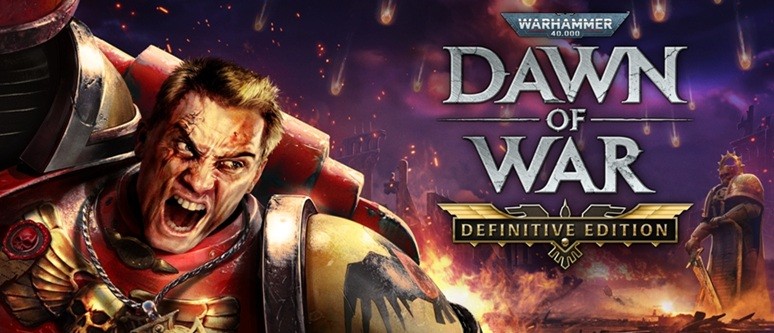
Warhammer 40,000: Dawn of War belongs to that lost age when 40K games were relatively thin on the ground, and where consequently each new release felt like a significant event. In an age where there is a massive library of 40K games available on Steam, it can't help but feel less special, though, since the bulk of that library is barely-playable shovel-ware, it still manages to stand out as something of a gem. It is also surprisingly one of only a handful of RTS games in the setting.
Dawn of War's initial campaign stars the Space Marines, as tradition all but dictates that the game's poster-boys need to be front and center for every new offering. The Orks, Eldar, and Chaos Space Marines serve as the campaign's antagonists in chronological order. From there though, the game's various expansions added campaigns for Imperial Guard, Eldar, Orks, Chaos Space Marines, Tau, Necrons, Sisters of Battle, and Dark Eldar. Indeed, the only major faction from the tabletop game not represented is the Tyranids, which at this point feels almost like a deliberate snub.
Rather than building individual units and manually grouping them into formations, like how things work in Starcraft and Warcraft, all infantry forces here are automatically grouped into squadrons and commanded as such. These squads can be customized with a certain number of special weapons that will make the squad more effective against certain targets (flamers to deal with hordes, heavy bolters to handle elite infantry, missile launchers for armour and buildings, etc). If the squad takes losses, you can spend some resources to replenish their numbers, and in short order, the unit will be combat effective again. Additionally, you can attach hero units to certain squads to give them additional abilities. This degree of customization makes up for the fact that none of the factions have very many different units, and since the bulk of your units are locked for most of the campaign, the available options will be even slimmer.
The game-play is satisfyingly simple real-time strategy, where you capture strategic points to get more resources, and use said resources to build/rebuild your army while you defend your bases and attack the enemy bases. There is not a huge variety of mission objectives during the first campaign, and indeed, after the 8th or so mission that boiled down to "assault the enemy position and kill everything that looks at you cross-eyed," I started to long for a few gimmick levels. That said, there is nothing wrong with the basic formula.
The treat here is how much personality your units have while they carry out your orders. In particular, it can be really fun to zoom in and watch all the neat animations that play when your guys get stuck into melee combat with the enemy. I am especially a fan of watching the Space Marine dreadnoughts do the little spin attacks that pound enemy units into the dirt. It does get a touch cartoony at times, especially when enemy artillery sends your unarmored imperial guard infantry flying, only to have the men spring back up to their feet and reform formations. In reality, these poor sods would be fertilizer after that.
What sets Dawn of War apart from the rest of the herd, though, oddly enough, is the voice acting. In particular, how all over the map it is in terms of quality and professionalism. You have campy B-movie performances like the chaos sorcerer Sindri, who is playing a scheming trickster so blatantly that you have to wonder how anyone could ever trust him. Even more over the top are the way the Khorne Berserkers scream out "Blood for the Blood God" with an intonation that makes you imagine the VA in the recording booth is actually frothing at the mouth. At the same time, you have the voice actor for Gabriel Angelos reading off each level's mission objectives in a polished faux-Shakespearean drawl that lends a weight and gravitas to every hill you need to capture and fortress you need to scour. Still, the most memorable performance has to go to the guy doing the voice acting for Force Commander Boreale, whose odd pronunciation, diction, and word-choice have inspired countless memes over the years.
Sub-Optimized
Dawn of War Definitive Edition is a faithful transfer of the original game, warts and all. More of a simple modernization effort to get the game to run on more recent systems than anything else. That said, the game has a few glaring issues that really should have been resolved before this rework hit the shelves.
The first thing you will notice is that the load times are obscene. This game is more than 20 years old, and I shouldn't have to wait five minutes for a campaign level to load up. Even more annoying though, is the fact that you have to sit through a loading screen to get to the main menu, followed by another loading screen after you select which of the four campaigns you would like to play. Do they really need a full loading screen just to show a list of ten or twelve missions with a difficulty selector?
The other issue I noticed while playing is a tiny complaint, but it does manage to be more than a little distracting. There is something seriously wrong with how some of the character portraits have been scaled up to the new resolution. Anyone with enough brains to keep their helmet on is left mostly unscathed by the ill effects, but everyone whose face you see looks more than a little off. The worst off is the Space Marine Librarian, though this is probably because his original open-mouthed portrait was already more than a little goofy.
As always, follow Hooked Gamers on Instagram for news updates, reviews, competitions and more.
8.0
fun score
Pros
Wide variety of Warhammer 40K factions, Simple but satisfying RTS gameplay, Delightful, though often absurd, voice-acting.
Cons
A lot of campaign missions feel too similar each other, Reworks of portraits look bizarre, Absurd loading times.


