Mick Gordon Live at PAX Aus 2026: Crafting Gaming’s Heavy Metal Identity

Feature
Brett: First off I just want to say: huge fan!
Mick: Yeah cheers mate, no worries! Oh thank you!
Brett: It's great to see Australians in the world scene of music. I went to university for audio engineering, I don't do it anymore. It's a difficult profession to get into, but I did do it for a bit, so I really love that you're able to get out there with it.
Mick: I appreciate that man, thank you.
Brett: How does your approach to composing change when you come on board with a project at the very start and really take the sound compared to when you come in maybe a little bit later when it's already got a bit of an audio identity and you have to flex toward that rather than doing your own thing?
Mick: Yeah it's really, honestly you've probably pretty much answered the question in the question there itself. So the way I like to think about it - I had this explained to me by Fredrik Thordendal from Meshuggah - and he said that every piece of art that you make exists in the universe somewhere, and because it exists in the universe it takes up space, and because it is taking up space it is improper for you to come along and try and put something else into that same space. So, you don't go along and try and do the same thing that somebody else has done, or to do the same thing that you've always done, your goal is to come up with something new, find the new space in the universe, you know, and I really love the way that he put that there. So whenever I'm coming on a project whether - I'm coming on at the start or coming on at the end - it doesn't matter, my process is still the same. I'm still trying to find that unique special thing that is very, I guess inherent to that project whatever it might be, so it can own it, it can be its own thing. I know people will step back and be like "Oooh this sounds like Mick has done it", but I want Defect to sound different to StarCraft to sound different to Warhammer to sound different to Doom, to sound different to Wolfenstein. A lot of the time is spent trying to come up with a unique angle for that there for sure.
Brett: That's super interesting, describing how it has its own space, that's a really cool way to look at it.
Mick: Yeah yeah, exactly. Yeah I imagine it like a sphere or something, and you can’t get into that same thing you know, you’ve got to come up with it differently.
James: Yeah, so I guess personally I've always loved video game music and soundtracks, particularly early on with Rareware and Grant Kirkhope.
Mick: Grant's a nice guy. He's really funny and he's jaded as hell.
James: Haha, yeah I've seen some of his interviews talking about the old days.
Mick: Yeah, yeah, yeah, he's funny as
James: In my head there used to be a clear difference between listening to a game soundtrack versus listening to a band, so I guess with the soundtrack to Doom I was just wondering how were you able to create something that can complement the gameplay so well and work so well in the game but that can also stand alone?
Mick: Good question! So, the music that I grew up loving like you said with Rareware, some of my favourites videogame scores were like Donkey Kong Country, but then like Sonic the Hedgehog and Mario Brothers whatever it is you know, Mario Kart, Killer Instinct, these soundtracks that I grew up with I loved the music, and I loved that phase where we had what was called Redbook audio, which was actual audio files that existed on the CD.
Brett: Pop in the Quake CD...
Mick: Exactly! So when you had, like, Mechwarrior Mercenaries 2 you could take the game CD put it in a CD player and it would play the music, you know what I mean. And some of my favourite music from like, Quake 2 I remember doing the same thing from it, just literally listening to the soundtrack, Sascha's soundtrack, Sonic Mayhem's soundtrack right there. So for me, it was always a thing, I was always listening to videogame music outside of videogames, so when I went in to doing this as a career that's all I wanted to do. I wanted to do the same thing - give people videogame soundtracks that they would listen to outside of games; it made sense to me. What I got disappointed with for a while and I still feel there's a bit of a hangover with this for games is trying to chase this Hollywood underscore type of thing; music that sits in the background. And I've heard other composers describe their music in a way that pisses me off, where they say "If someone's noticed your music, you've done a bad job. The music is just meant to sit in the background and suggest an emotion", and I'm like that's such a f#^&ing cop-out you know what I mean like, it's not a film, it's a videogame. I have my comfy couch, I've knocked off for the day, my girlfriend's out of town, I'm sitting on my couch with my Doritos and I want to play a f#^&ing videogame, you know what I mean. I want to hear music that fits that! Not watch a film!
Brett: Not just something that elicits emotion, but complements it.
Mick: Yeah exactly, it’s not Martin Scorsese, it’s a videogame, you know what I mean? It’s its own thing, and so the music that I make has always been driven by that. To me, not to do that I would actually really have to try hard not to do it, if that makes sense.
James: What were some of the other influences on you growing up from game music and from a sound design perspective? I mean if you're listening to the Quake CDs and Mechwarrior 2 and that sort of stuff, what other stuff?
Mick: Yeah I mean Quake 2 I think if you want to hear what I did with Doom, Sascha's Quake 2 soundtrack was fantastic; and Sascha when we played at The Game Awards he was doing the keyboards, he was on stage with me there and that was really, that was a really incredible moment just for me there to have him on stage, that was really damn cool, he's a really really cool guy. There were lots of different game soundtracks at the time, I mean one of my favourites is just the Half-Life 2 soundtrack man, that moment where you're just getting in and that bass part starts with the synths *starts imitating 'CP Violation' from the Half-Life 2 soundtrack* it's like "Woooaaah" and straight away I'm in City 17 you know what I mean; it just very quickly gets into that there, I love that stuff. I mean there was obviously Dooms and Wolfensteins and Duke Nukems and things like that.
My first GDC was in 2006, I was twenty years old, I couldn't drink because it was in the states because it was in America, and I met a guy there named Will Roget, and Will became a good friend of mine, Will's now a really big videogame composer and does like Mortal Kombat and Call of Duty and all this sort of stuff, he's a really really cool guy he just did Helldivers which was an amazing score.
Brett: Good soundtrack yeah.
Mick: Yeah, really, really good. And he was a little bit older and he was able to sneak me glasses of wine and we both got drunk and sung God of War together; but anyway that's a different story. Where were we, what was your question? It was about?
James: Influences! Sound design!
Mick: Other influences! That's right! So, when travelling to GDC over a number of years I got to meet someone who went on to become my mentor, and the guy's name was Charles Deenen. Charles has had an incredible career, he would've worked on over 200 games or something, he did his first game when he was like 13 years old and he went on to do games like Descent and things like that and he now does like Call of Duty and things, he's incredible. But he became my mentor and I worked under Charles for a number of years when he was Audio Director at EA doing the Need for Speed franchise. And Need for Speed is the same damn game every year it's a racing game, you get in a car your goal is to get to the finish line before everybody else; that's the game. What they had to do when they were releasing one of these a year was to come up with a unique creative process behind each one to make each one stand out, and so Charles, his job was to try and make Need for Speed: Shift sound very different to Shift 2 to sound very different to The Run to sound very different to Most Wanted to sound very different to Hot Pursuit. It was the same team each time, they had to reinvent their creative process every single time; and so all of my sound design, music technique stuff I learnt from Charles, he was very big on clarity, but punch and distortion and loudness, but it needed to be not muddy, it needed to be clear and aggressive you know. When you're distorting the hell out of something it can just very quickly become noise.
Brett: Just a sausage
Mick: Just a sausage yeah! And he was brilliant and he still is brilliant at coming up with stuff that sounds *mimics bass* like it has a punch to it you know, it feels like it's jumping out the speakers at you. Yeah so, I learned all my stuff from Charles.
Brett: You mentioned Killer Instinct and Doom, how do you change your approach when you're working on a project that's obviously got a lineage to it like Doom or Killer Instinct that has a remake or a reboot or something like that, versus something that's brand new like Prey for example; where you don't have that identity in it. I guess it feeds a little into my previous question as well, but I know there are obviously a lot of callbacks in Killer Instinct, in Doom as you said the main title in that. What’s the difference there?
Mick: Yeah, again it's project based so it depends. Every project is different, there's not one way of rebooting a game you know what I mean. I've been fortunate enough to not only be in a position where I've rebooted a few franchises, but also rebooted franchises of games I played as a kid.
Brett: Killer Instinct is probably one of them.
Mick: Yeah! Oh man, Killer Instinct. I still - I have two games in my studio - I only have two games in there and they're both my copy of Killer Instinct for the Super Nintendo I played as a kid and my copy of Doom that I played as a kid.
So I have those on my shelf up there, they're kind of cool. Yeah so, each one's different, Killer Instinct needed to feel modern. It needed to feel like a game that came out today. Of course that was 2013, but at the time it needed to sound like a Killer Instinct game that still felt like Killer Instinct but was coming out today. And that was really the first time I'd been able to pull a nostalgic something from the past, and there were a couple of things that I was really conscious of. One: it really pissed me off when somebody was handed a franchise that was really important to a fanbase and then they disrespected it by completely ignoring the lineage. I'm not going to pull out examples because I don't want people to like chase up things that I might have just said something bad about.
Brett: *laughs* That’s probably a smart thing, don't worry about it.
James: *laughs* It's off the record, off the record! *laughs*
Mick: No, no, I mean it’s fine, like, to have a Killer Instinct game that didn't have the theme would not make sense. To me that would be disrespectful not to the franchise itself but also to the fanbase that had been loyal behind it, you know what I mean. So, that was a big driving force there. Then I jumped onto Wolfenstein, but Wolfenstein was a VERY different game to the others, it was more like Quentin Tarantino doing something in the sixties, it was more like Inglorious Basterds inspired, it really, I mean the distance just technologically from Wolfenstein: The New Order to the original Wolfenstein is like so far that there really wasn’t a way of doing it in a way that kind of worked. I did pull some themes from Wolfenstein for one cutscene in The New Colossus; there's only a few small fans that have picked up on it and it's a really awkward cutscene where they're having a birthday party for BJ Blazkowicz, and the music for that whole scene is based on the original first music you hear when you're playing Wolfenstein. But that was the only opportunity it was really hard to do any other way. Now Doom for example was very different, with Doom what I wanted to capture was that feeling that I had of playing Doom back in the nineties, early nineties, as a young kid which came with a feeling that I shouldn't be playing it.
Brett & James: *laughs*
Mick: It was like watching a movie that was too mature for me or reading a magazine that was clearly for eighteen year-olds, or you know watching a movie that I think was definitely a bit beyond me or something like that, it was doing or listening to a song that was like "Hang on, am I being sold satanism if I listen to this?". You know it was this feeling that playing Doom was somehow wrong in a way. The other thing that was really important with capturing the Doom thing there, which is why I love this question. Is playing Doom in the nineties felt really modern, it felt like you were looking into the future, it felt real, it felt like there was this world that you were actually in that you were exploring around. It wasn't like a, you know a sidescroller or something like that or like an old Atari 2600 game or an arcade game or something, it felt like you were in a world. It was so technologically advanced for the time, and so when we were doing Doom 2016, we wanted the music to feel the same. If to do something that felt like it had come from the nineties felt looking back instead of looking forward.
Brett: Yeah I think you clocked that really well.
James: Out of all the songs you've composed for games, what are some sleeper hits that we can go back and listen to after the interview.
Mick: Oh man I never listen to my stuff.
James & Brett: Really?!
Mick: Yeah I never do. I never listen to stuff, I never read my interviews, I never watch anything; I have no idea I never go back.
Brett: That’s probably a good thing actually.
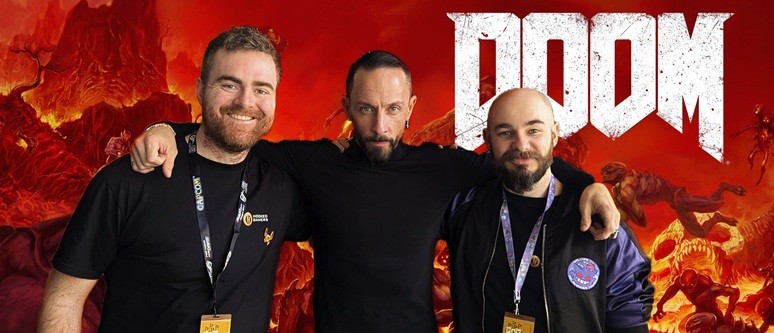
Mick: I have no idea, I'm in this incredible position where I'm able to take this music that we did for Doom and do it live. So I'm going to be headlining RADAR next year which is going to be really exciting. I'm going to be playing Doom with a live band and a live orchestra in Sheffield, England, then I'm going to be doing Brutal Assault which is like the week after in the Czech Republic with a huge 25,000 audience. So, I'm actually having to go through and listen to things. If you said, like, what's track so-and-so on the Doom soundtrack...I couldn't tell you. I literally don't ever check it out. It shows up in my feeds and whatever because there's like some guy with a guitar playing The Only Thing They Fear is You or whatever, and that's cool. I love that - don't get me wrong - but I just never go back and listen to it. I'm making so much music all the time I forget stuff. Some people will be like "Oh, I love that song", and I'm like "Oh I forgot, I can’t even remember doing it".
James & Brett: *laughs*
Mick: Yeah that's a good question, I appreciate it!
Brett: This one's a bit more on the production side. If you could only have three pedals or plugins in your chain, what would they be?
Mick: Well pedals and different plugins which do you want? One for plugins, one for pedals?
Brett: Three of each.
Mick: Oh my god!
James & Brett: *laughs*
Brett: Yeah only three because I know you work with a lot sometimes.
Mick: Yeah I do, I do. I would say if I had to pick one plugin it would be MXXX from Melda, because it has kind of everything in it. It's a bit of a catch-all because it has everything you want to do in it. But probably my main one would be some sort of wave shaper because I can do whatever I want with a wave shaper: I can make things louder, I can rectify a signal, I can compress a signal; it's just a very diverse thing. If somebody was after one thing that you need, it's not because it sounds the best, it's because it just allows me to do a lot. My big philosophy, which came from Charles, was techniques not tools, there's never one special plugin or pedal that I couldn't live without, because it's the technique and thinking behind it that leads to it. Because if it breaks, if it fails, if you don't have it, if the license doesn't work, if it's subscription based, if you don't have it, whatever it is, I still need to be able to do my job. So my job isn't "I need this compressor plugin", its I need a compressor, or I need to compress a signal - it's the technique itself, and there's different ways of doing it, multiple different ways.
Brett: 100%. That's a good way to be.
Mick: Exactly! Yeah! There's definitely pedals I love because they feel like they're more of a collaborator, rather than something else. So if I've got some weird Metasonix thing from 20 years ago with some offensive artwork on it, it's gonna do something really unpredictable. I don't know what it's going to do. If I put this here, and this here, and this here, I'm not trying to get something specific, I know when I do that, it's going to do something that I don't expect, so I'm collaborating with it - if that makes sense.
Brett: I love that way of looking at it.
Mick: Yeah it's not a tool at that point, I'm working with what it gives me. And I love that because I feel there's something really tangible about working with an analogue pedal because it feels I'm taking - when you look at electricity you see it’s just a bunch of electrons jumping around really rapidly from ones to zeroes or this place to this place or whatever it is. You're taking those electrons, they're alive, out of the wall unit and into a pedal and I'm running my music through it. Those little electrons are now collaborators on my signal, and they're doing their own little thing, you know what I mean? When it's digital and it's just bits going up and down, ones and zeroes, I don't feel it's the same, but when there's electrons moving around, I feel like that little living force is now a collaborator on whatever it is I'm working with.
Brett: So you're a fan of the analogue?
Mick: Yeah all analogue, my whole studio is. I look at my front unit there, it's a Super15 Culture Vulture, sits right in front of me the whole time, and I have 500 series behind that, and then a Eurorack system over here, and lots of weird obscure old shit that nobody...
Brett: They're the best.
Mick: Yeah, one of my favourites is this old preamp of an old 1950s Ampex tape recorder, like a reel-to-reel tape recorder, where you will see guys like David Attenborough from the 1950s out in some jungle in Papua New Guinea with this giant thing that weighs like twenty kilograms that's got a giant tape here, but it had an amplifier section on top of it, it had like six or seven valves in it; but I have a unit that is just that top part, it doesn't have the tape section, and I had an engineer put it into a box for me, and I can run signals through it and man it sounds so good, it's such a great preamp.
Brett: Awesome, I think we're out of time. Thank you so much, it's been super insightful, I love your thought process on this sort of stuff
As always, follow Hooked Gamers on Instagram for news updates, reviews, competitions and more.